Wanderlines guide
Astrocartography explained, what it is and how to read your lines
The sky at your first breath, laid over the whole world like a map
Astrocartography is an astrology technique that maps your birth chart onto the globe. At the minute you were born, every planet was rising, overhead, setting or underfoot somewhere on Earth, and astrocartography draws those places as forty lines. Astrologers read living or travelling near a line as turning up that planet's themes, which makes the map a lens for choosing where to go.
Updated 12 October 2026
What is astrocartography?
Some cities feel as if they were waiting for you, and others flatten you for no reason you can name. Astrocartography is an astrology technique that projects your birth chart onto a map of the world, marking every place where a planet rose in the east, stood at the top of the sky, set in the west or lay directly beneath your feet as you arrived. Each set of places becomes a line, and a full map holds forty of them.
Tradition reads the ground near a line as a place where that planet's themes grow louder in your life, for a fortnight's holiday or for years. Think of the city where the light was right from the first morning, where the streets made sense at once and a stranger at the bus stop talked to you like an old neighbour. Astrocartography offers one way to ask why, drawn straight from the sky you were born under.
Where do astrocartography lines come from?
Astrocartography lines come from the real sky at your birth, calculated as it looked from the centre of the Earth. Imagine that minute from far out in space. The Earth is a turning ball, half in daylight, and every planet hangs at a precise point around it. Somewhere on that ball Venus is just lifting over the eastern horizon. Somewhere else it stands at its highest, in a third place it is sinking in the west, and on the opposite face of the globe it sits straight beneath the ground.
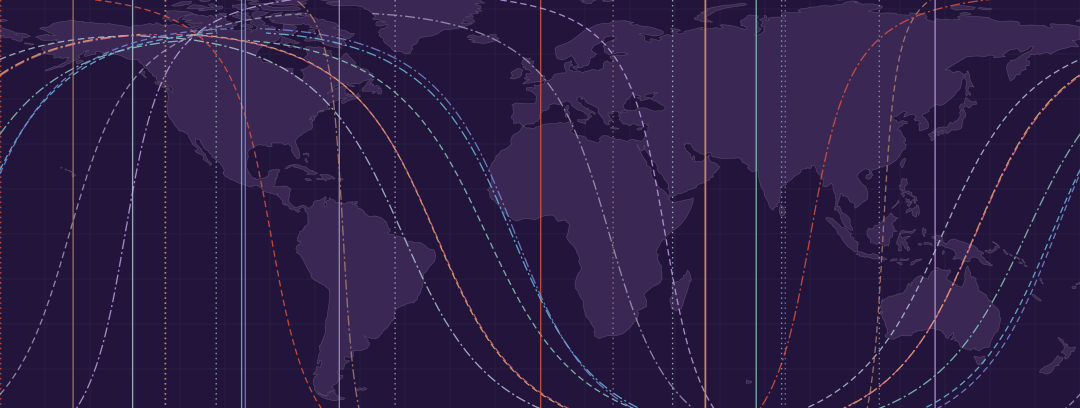
Join up all the spots where Venus, or any other planet, was doing one of those four things and you get a line. The overhead and underfoot lines are meridians, running pole to pole along a line of longitude. The rising and setting lines curve with the tilt of the horizon, bend hard at high latitudes and, for a planet far from the celestial equator, stop altogether near the poles, where that planet never rose or never set that day. Ten planets on four angles make forty lines.
This part is pure astronomy. Given an exact birth time and place, anyone with a good ephemeris can check where each line falls and get the same answer. Because the Earth keeps turning, a birth time that is slightly out shifts the whole set of lines sideways, which is why the minute matters. The world map below draws every line of one sample chart, so you can see how they weave and cross before you look for your own.
The four kinds of astrocartography line
The four kinds of astrocartography line are the rising (AC), overhead (MC), setting (DC) and underfoot (IC) lines, one for each angle of a chart. On the AC line the planet sat on the eastern horizon, which puts it on your relocated Ascendant at the edge of your 1st house. Astrologers read it in your body, your energy, your first impressions and how you feel in your own skin, from the moment you wake.
The MC line puts the planet on your relocated Midheaven, the top of the chart and the cusp of your 10th house. This is the public line of career, reputation, calling and being seen, usually read as the most visible of the four. Colleagues, bosses and complete strangers meet the planet there before they meet anything else about you.
The DC line puts the planet on your relocated Descendant and your 7th house, so you tend to meet it through other people, carried to your door by partners, clients, close friends and open rivals. The IC line sits at the bottom of the chart on your 4th house, the ground of home, family, roots and private life. It works slowly, felt at the kitchen table more than in the street. Each angle has its own icon in the set below.
Where the planet was coming up over the horizon. How you come across and the energy you carry there.
Where the planet was at its highest. Career, reputation and how the world sees you.
Where the planet was going down. Relationships, partners and the people you meet.
Where the planet was directly below. Home, roots, family and private life.
What each planet brings to a line
Each planet brings its own subject to a line, while the angle decides where in your life it lands. Sun lines bring confidence, vitality and the feeling of being fully yourself. Moon lines touch home, moods and belonging. Mercury lines sharpen the mind and fill the days with talk, study and letters. Venus lines are the soft ones, carrying love, beauty, pleasure, friendship and money that arrives a little easier.
Jupiter brings growth, generosity, teachers and luck, sometimes with too much of a good thing. Mars brings drive, courage, heat and competition, plus the urge to finish everything by Thursday. Saturn asks for structure and hard work and pays it back in lasting achievement. Uranus brings freedom and surprise, Neptune brings dreams, music and a pleasant haze, and Pluto brings depth, intensity and the kind of change that rearranges the furniture of a life.
Traditional astrologers call Venus and Jupiter the benefics and Mars and Saturn the malefics, yet a hard line is never a curse. A Saturn line can be exactly where a serious career gets built, and a Pluto line can be where an old version of you is finally set down. Each of the forty lines has its own page, listed below, if you want to read yours in full.
How to read an astrocartography map, step by step
Reading an astrocartography map means finding the lines near a place, naming each one by its planet and angle, and holding the result up against your life. Start with your birth details, as exact as you can find them. A birth certificate or hospital record beats a family memory, because a small error drags the whole map sideways. Then open the map and let your eyes wander before you search for anything, noticing which lines pass near home, near where you grew up and near the places that changed you.
Next, pick a place and look at its closest lines. Most astrologers read a line as strongest within a few hundred kilometres, softening with distance, and a line out at sea is felt most on the nearest coasts. Say the planet and the angle together, Venus setting or Saturn overhead, and read them as one sentence about that place.
Then hold the map up against your past. Perhaps a love affair began near a Venus line, or you worked like a demon somewhere close to Mars overhead. Patterns in places that already mattered are the best evidence you will get about your own map. Last, look at where two lines cross, spots read as doubly charged, and treat the open stretches between lines as calm, ordinary ground.
What astrocartography can and can't do
Astrocartography can place every planet on its angles with astronomical precision, and nothing in that part is a matter of belief. What a line means comes from astrological tradition. No scientific study has shown that moving to a Jupiter line makes anyone luckier. Hali says so plainly and still finds the map well worth reading.
Used well, the map is a lens for reflection and choosing. It can explain why one city felt like your own handwriting from the first day, suggest where to spend a sabbatical, or give you words for a restless year. It cannot promise love, money, health or safety anywhere, and it cannot outvote rent, work, language and friends, which sometimes count for more than any planet.
Who invented astrocartography?
Astrocartography was developed and named by the American astrologer Jim Lewis in the nineteen seventies, though the idea beneath it is much older. Astrologers have cast relocation charts for centuries, recalculating the angles and houses for wherever a person actually lived. What they lacked was a way to see the whole world at once, every possible home laid out on one page.
Lewis supplied that page. His printed maps showed every line together, so anyone could look at a single sheet and see every planet's angles at once. The same calculation now runs in a moment on the phone in your pocket, and it still starts from one minute of sky.
How to see your own astrocartography map for free
Wanderlines is Hali's free astrocartography map. Add your birth date, time and place and it draws all forty of your lines, then reads any city you tap, with the distance to every line nearby. No time yet is fine. The map shows the wide bands where each line could fall, so you can explore while someone hunts for the certificate.
Begin with a place you know by heart, the town where you grew up or the city that changed your mind about everything. Then try one you have only dreamed about. A line may already run through it, waiting to be read. The button below opens your own.
Your map is waiting. It takes your birth date, time and place, and it is free.
Open my free mapQuestions people ask
What does astrocartography mean?
Astrocartography means mapping the planets of your birth chart onto the Earth. Each line marks the places where one planet sat on the horizon or the meridian as you took your first breath. Places close to a line are read as turning up that planet's themes for you.
How many lines are on an astrocartography map?
A standard map has forty lines, one for each of the ten planets on each of the four angles. Some maps add the lunar nodes, Chiron or asteroids as extras. The forty planet lines are the heart of every reading.
Do I need my exact birth time for astrocartography?
As close as you can get. The Earth turns a little every minute, so a time that is slightly out shifts every line across the map. Without a time, a map can still show the wide bands where each line could fall.
Which astrocartography line is the best?
No single line is best for everyone. Venus and Jupiter lines are the traditional favourites for ease and pleasure, Sun lines and MC lines suit being seen, and Saturn lines suit building something that lasts. The best line is the one that matches your wish for a place right now.
Does a line affect me if I only visit?
Many astrologers say yes, more gently. A trip gives a sample of the line, while living there keeps its theme running every day. Travel is a kind way to test a line before you commit to it.
Is astrocartography the same as a relocated chart?
They use the same idea from two directions. A relocated chart recasts your birth moment for one chosen place and reads every planet's house there. Astrocartography shows the whole world at once, marking only the spots with a planet exactly on an angle.
More from the guide
- How accurate astrocartography is, and whether it worksThe sky part is exact. The meaning part is yours to test
- Astrocartography vs relocation chart, and when to use eachSame sky, same minute, a new place to stand underneath it
- Astrocartography line crossings and parans, explainedWhere two of your planets touched their angles at once, and the belt they left
- How far an astrocartography line reaches, and how close you need to beA line is drawn as a thread, but you live inside its glow
- Best places to live by astrology, mapped with astrocartographyThere is no single perfect city, only the right place for what you want next
Somewhere on the map, a city is already waiting for you. Find out which one.
Open my free map