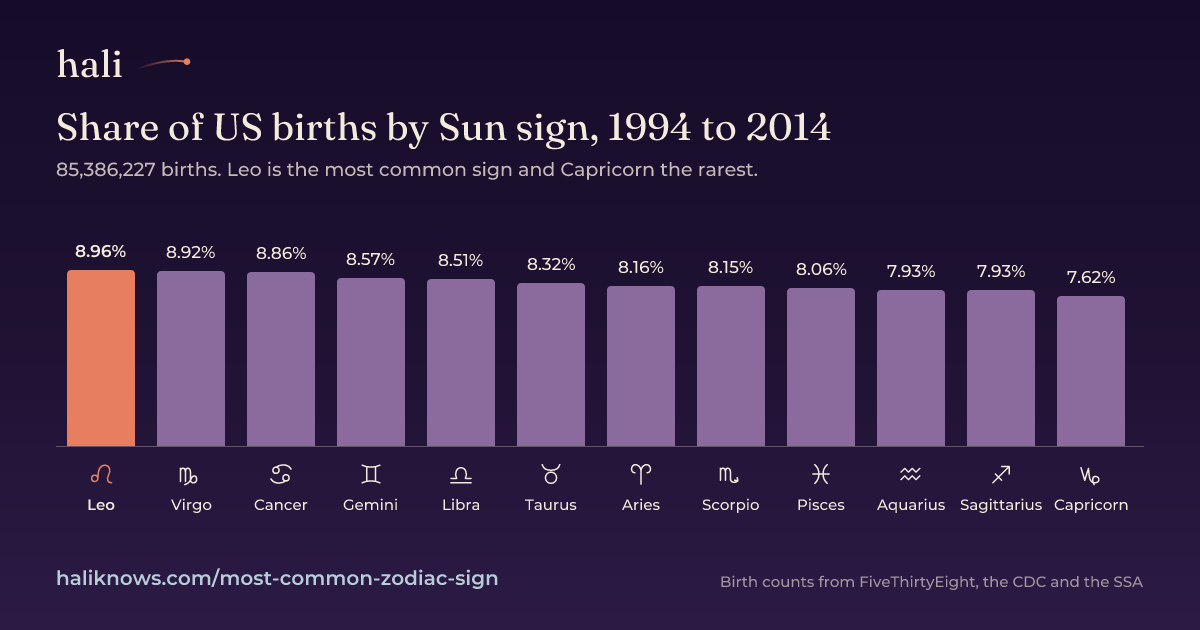
Leo is the most common zodiac sign and Capricorn is the rarest. We took every birth recorded in the United States from 1994 to 2014, 85,386,227 babies, and sorted each day’s births into Sun signs using the exact moment the Sun entered each sign. Leo has 8.96% of births. Capricorn has 7.62%.
That gap is real but small. Out of every 1,000 babies, about 90 are Leos and 76 are Capricorns. If every sign were equal, each would get about 83.
Which zodiac sign is the most common?
Leo, by a whisker. Here are all twelve signs, from the most common to the rarest.
| Sign | Share of births | Rank | Season length | Share from length alone | Births per day |
|---|---|---|---|---|---|
| Leo | 8.96% | 1 | 31.30 days | 8.57% | 11,642 |
| Virgo | 8.92% | 2 | 30.90 days | 8.46% | 11,738 |
| Cancer | 8.86% | 3 | 31.45 days | 8.61% | 11,455 |
| Gemini | 8.57% | 4 | 31.33 days | 8.58% | 11,123 |
| Libra | 8.51% | 5 | 30.39 days | 8.32% | 11,386 |
| Taurus | 8.32% | 6 | 30.96 days | 8.48% | 10,929 |
| Aries | 8.16% | 7 | 30.49 days | 8.35% | 10,878 |
| Scorpio | 8.15% | 8 | 29.86 days | 8.17% | 11,095 |
| Pisces | 8.06% | 9 | 29.97 days | 8.21% | 10,937 |
| Aquarius | 7.93% | 10 | 29.59 days | 8.10% | 10,902 |
| Sagittarius | 7.93% | 11 | 29.56 days | 8.09% | 10,913 |
| Capricorn | 7.62% | 12 | 29.44 days | 8.06% | 10,524 |
Aquarius and Sagittarius are tied to two decimal places.
Why are some signs more common than others?
Two things are going on, and they are easy to mix up.
The signs are different lengths. The Earth moves faster in its orbit in January than in July, so the Sun crosses the winter signs more quickly. Cancer season averages 31.45 days and Capricorn season 29.44. Even if babies arrived at a perfectly steady rate, Cancer would collect 8.61% of births and Capricorn 8.06%. That is the “share from length alone” column.
Births follow the seasons. In these records, the busiest month is September, with an average of 11,764 births a day, and the quietest is January, with 10,678. Summer and early autumn are busy. Midwinter is quiet. The births per day column shows it sign by sign. Virgo averages 11,738 a day, the most of any sign, and Capricorn 10,524, the fewest.
Leo has 17.6% more births than Capricorn. Part of that is length, because Leo season is 6.3% longer. The rest is the seasonal pattern, because Leo season averages 10.6% more births per day. In share terms, Leo is 1.34 points ahead of Capricorn, and 0.51 of those points come from the length of the seasons and 0.83 from the time of year.
Virgo is the interesting one. It has more births per day than Leo, but Leo season is longer, so Leo ends up with more people overall.
Is Aquarius the rarest zodiac sign?
Not in these records. You’ll often read that Aquarius is the rarest sign. In US births from 1994 to 2014, Aquarius ties with Sagittarius for second rarest at 7.93%. Capricorn is clearly rarer, at 7.62%.
Capricorn has two things against it. Its season is one of the shortest of the year, and it runs straight through Christmas and New Year, when far fewer babies are born.
What are the most common birthdays?
September owns the top of the list. Nine of the ten most common birthdays fall in September, and the most common of all is September 9, with an average of 12,301 births a day. The only outsider in the top ten is July 7.
| Rank | Birthday | Average births that day |
|---|---|---|
| 1 | September 9 | 12,301 |
| 2 | September 19 | 12,229 |
| 3 | September 12 | 12,224 |
| 4 | September 17 | 12,148 |
| 5 | September 10 | 12,143 |
| 6 | July 7 | 12,108 |
| 7 | September 20 | 12,107 |
| 8 | September 15 | 12,087 |
| 9 | September 16 | 12,072 |
| 10 | September 18 | 12,055 |
A common explanation for the September peak is that it falls about nine months after the December holidays. These records show when babies were born, not why, so treat that as a likely story rather than a finding.
What are the least common birthdays?
Holidays. The rarest birthday is Christmas Day, with an average of 6,574 births, followed by New Year’s Day, Christmas Eve and the Fourth of July.
| Rank | Birthday | Average births that day |
|---|---|---|
| 366 | December 25 | 6,574 |
| 365 | January 1 | 7,792 |
| 364 | December 24 | 8,069 |
| 363 | July 4 | 8,796 |
| 362 | January 2 | 9,307 |
| 361 | December 26 | 9,543 |
| 360 | November 27 | 9,718 |
| 359 | November 23 | 9,883 |
| 358 | November 25 | 9,954 |
| 357 | October 31 | 9,978 |
November 23, 25 and 27 are on the list because Thanksgiving lands on them in many years.
How much do holidays change births?
A lot. Many births are scheduled, through planned caesareans and inductions, and few are booked for a public holiday. To measure each holiday fairly, we compared it with the days one to three weeks either side of it in the same years, leaving out the Christmas and New Year stretch and the other holidays.
| Holiday | Births that day | Days around it | Change |
|---|---|---|---|
| Christmas Day | 6,574 | 11,005 | 40.3% fewer |
| Thanksgiving | 7,430 | 11,055 | 32.8% fewer |
| New Year’s Day | 7,792 | 10,991 | 29.1% fewer |
| Christmas Eve | 8,069 | 10,975 | 26.5% fewer |
| Fourth of July | 8,796 | 11,469 | 23.3% fewer |
| Halloween | 9,978 | 11,120 | 10.3% fewer |
| New Year’s Eve | 10,394 | 11,013 | 5.6% fewer |
| Leap day | 10,462 | 10,972 | 4.6% fewer |
| Valentine’s Day | 11,636 | 10,899 | 6.8% more |
Valentine’s Day is the one holiday that gains babies. Halloween loses about one in ten. Leap day has only five years of data here, 1996 to 2012, so its figure is the least certain on the list.
The day of the week matters even more. Tuesdays average 12,788 births and Sundays 7,610. That doesn’t skew the birthday rankings, because over 21 years every date lands on every day of the week several times.
Does a rare sign mean anything?
No. A rarer Sun sign doesn’t make anyone luckier or more special, and the differences here are small. What they do tell you is that holidays, hospital schedules and the seasons shape when people are born, and that shows up in the zodiac too. If you’re a Capricorn, there really are slightly fewer of you around, which may be why your birthday party clashes with everyone else’s holiday plans.
Want to know more than your Sun sign? Your rising sign has its own rarity story, and your birthday page shows exactly where the Sun stood on the day you were born.
How we calculated this
We used daily US birth counts published by FiveThirtyEight under a CC BY 4.0 licence. They come from the CDC National Center for Health Statistics for 1994 to 2003 and the Social Security Administration for 2000 to 2014. Where the two overlap, we used the CDC counts, so our series is CDC for 1994 to 2003 and SSA for 2004 to 2014. In the four years both cover, the SSA counts run about 2% higher than the CDC counts. That shifts every day of a year by the same amount, so it barely touches the shares.
The series covers all 7,670 days from 1 January 1994 to 31 December 2014, with an average of 11,132 births a day. It covers births in the United States only. Other countries have different holidays, different hospital practice and, south of the equator, opposite seasons, so their rankings could look different.
For each day, we found the Sun’s sign from the exact moments it entered each sign, calculated by our chart engine to the minute. The records give the date of birth but not the time or place, so we treated each date as the day from midnight to midnight in US Central time, close to the middle of the US population, and assumed births were spread evenly through it. On the 250 days in the series when the Sun changed sign, we split that day’s births by the share of the day before and after the change. Rerunning the split with Eastern or Pacific time moves no sign’s share by more than 0.002 percentage points and doesn’t change the order.
A sign’s “share from length alone” is its share of all the days in the series. Its births per day is its births divided by the length of its seasons. A birthday’s average is its births divided by the number of years it occurred, which is 21 for every date except February 29.
The script that builds the dataset is in our code, so every number on this page can be rebuilt from the source files.
Use this data
The full dataset is free to use under a Creative Commons Attribution licence (CC BY 4.0). Download the sign and birthday tables from the tool above. If you write about it, please credit Hali and link to this page, and credit FiveThirtyEight, the CDC and the Social Security Administration for the birth counts. For questions or custom cuts of the data, contact us at hello@haliknows.com.
Cite this study
The findings, the chart and the data are free to use. All we ask is a credit to Hali and a link back to this page.
The chart
Citation
Hali Knows team (2026). The most common and rarest zodiac signs, from real birth records. Hali. Published 27 October 2026. https://haliknows.com/most-common-zodiac-sign
The data
Embed the chart
Paste this HTML into your page. It shows the chart and links back to the study.
<a href="https://haliknows.com/most-common-zodiac-sign"><img src="https://haliknows.com/charts/most-common-zodiac-sign.png" alt="Bar chart of the share of US births by Sun sign from 1994 to 2014. Leo is the most common at 8.96% and Capricorn the rarest at 7.62%." width="1200" height="630" style="max-width:100%;height:auto"></a>
<p>Chart by <a href="https://haliknows.com/most-common-zodiac-sign">Hali</a>, CC BY 4.0</p>Hali's findings, chart and data are free to use under a Creative Commons Attribution licence (CC BY 4.0). Credit Hali and link to this page. Read the licence
The daily birth counts underneath come from FiveThirtyEight's data repository, which is also under CC BY 4.0. Please credit FiveThirtyEight, the CDC and the Social Security Administration for them too.
Questions people ask
What is the most common zodiac sign?
In US birth records from 1994 to 2014, Leo is the most common Sun sign, with 8.96% of births. Virgo is a close second at 8.92% and Cancer third at 8.86%. Virgo has the most births per day, but Leo season runs a little longer, so Leo ends up with more people.
What is the rarest zodiac sign?
Capricorn, with 7.62% of US births from 1994 to 2014. Its season is one of the shortest, and it falls over the Christmas and New Year holidays, when far fewer babies are born. Sagittarius and Aquarius tie as the next rarest at 7.93% each.
Is Aquarius the rarest zodiac sign?
Not in these records. Aquarius ties with Sagittarius for second rarest at 7.93% of births. Capricorn is rarer, at 7.62%.
What is the most common birthday?
September 9, with an average of 12,301 US births a day from 1994 to 2014. Nine of the ten most common birthdays fall in September. The tenth is July 7.
What is the least common birthday?
December 25. An average of 6,574 babies were born in the US on Christmas Day, about 40% fewer than on the days around it. January 1, December 24 and July 4 come next.
Is my zodiac sign rare?
Every sign is fairly common. Even the rarest, Capricorn, is about 76 in every 1,000 US births, against 90 for Leo. If signs were perfectly equal, each would be about 83.
Can I use this data?
Yes. The dataset is free to use under a Creative Commons Attribution licence (CC BY 4.0). Please credit Hali and link to this page, and credit FiveThirtyEight, the CDC and the Social Security Administration for the birth counts.
Sources
- Daily US birth counts from FiveThirtyEight's data repository (github.com/fivethirtyeight/data, births folder), CC BY 4.0, downloaded 27 October 2026
- Counts for 1994 to 2003 from the CDC National Center for Health Statistics, and for 2004 to 2014 from the Social Security Administration
- Sun sign ingress times computed by Hali from astronomy-engine (MIT licence), to the minute