How rare is your Big Three?
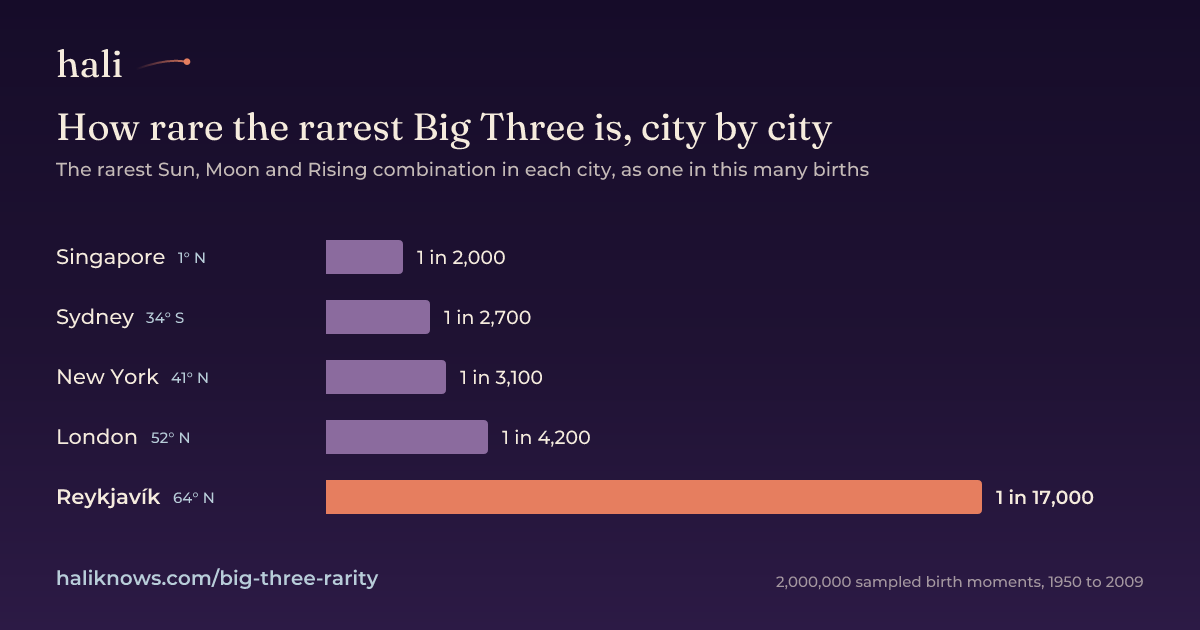
The rarest Big Three is a Capricorn Sun with a Capricorn Moon and whichever rising sign is rarest where you were born. In London that means Aries or Pisces rising, about 1 in 4,200 births. The most common Big Three there, a Leo Sun and Taurus Moon with Leo, Virgo, Libra or Scorpio rising, is about 1 in 1,100. That’s a gap of 3.7 times. In Singapore the gap shrinks to 1.3 times, and in Reykjavík it grows to 19.4.
Pick your Sun, Moon and Rising sign and where you were born to see how many people share all three.
Only latitude matters, so if your city is not listed, pick the latitude nearest to it.
Choose your Sun, Moon and Rising sign to see how many people share all three.
Download the data (CSV), free to use under CC BY 4.0
How many Big Three combinations are there?
There are 12 Sun signs, 12 Moon signs and 12 rising signs, which makes 1,728 combinations. If they were all equally common, each one would turn up in 1 of every 1,728 births. They aren’t, for three reasons, and one of them matters far more than the other two.
Why are some Big Three combinations rarer than others?
Your rising sign does most of the work. Some signs cross the eastern horizon much faster than others, and the further you are from the equator, the bigger the difference. In London, Aries rising accounts for 3.64% of births and Libra rising for 11.85%. Our rarest rising sign study explains why, city by city.
Your Sun sign matters a little. Earth’s orbit is slightly oval, and Earth moves fastest in early January. So the Sun crosses Capricorn in about 29.5 days and takes about 31.5 days over Cancer. With births spread evenly through the year, Capricorn Suns make up 8.06% of births and Cancer Suns 8.61%.
Your Moon sign on its own barely matters. Over the 60 years we sampled, every Moon sign lands between 8.30% and 8.36% of births, close to an even twelfth. What does vary a little is how the Moon pairs with the Sun. The Moon moves slightly faster around the new and full Moon, so it spends a little less time in the Sun’s own sign. Sun and Moon share a sign in 8.18% of births, not the 8.33% an even split would give.
Put the Sun and Moon together and the rarest pair, a Capricorn Sun with a Capricorn Moon, turns up in about 1 in 152 births. The most common, a Leo Sun with a Taurus Moon, turns up in about 1 in 136. Both ends are close calls. Aquarius Sun with Aquarius Moon comes within 1% of the rarest pair, and Leo Sun with Scorpio Moon within 1% of the most common.
Your rising sign is a separate matter. With births spread through the day, every rising sign is as likely on one date as on any other, so it doesn’t depend on your Sun or Moon. That’s why the share of a Big Three is simply the share of its Sun and Moon pair times the share of its rising sign where you were born.
The rarest and most common Big Three, city by city
| City | Rarest Big Three | About 1 in | Most common Big Three | About 1 in | Gap |
|---|---|---|---|---|---|
| London | Capricorn Sun, Capricorn Moon, Aries or Pisces rising | 4,200 | Leo Sun, Taurus Moon, Leo, Virgo, Libra or Scorpio rising | 1,100 | 3.7× |
| New York | Capricorn Sun, Capricorn Moon, Aries or Pisces rising | 3,100 | Leo Sun, Taurus Moon, Leo, Virgo, Libra or Scorpio rising | 1,300 | 2.4× |
| Sydney | Capricorn Sun, Capricorn Moon, Virgo or Libra rising | 2,700 | Leo Sun, Taurus Moon, Taurus or Aquarius rising | 1,300 | 2× |
| Reykjavík | Capricorn Sun, Capricorn Moon, Aries or Pisces rising | 17,000 | Leo Sun, Taurus Moon, Leo or Scorpio rising | 900 | 19.4× |
| Singapore | Capricorn Sun, Capricorn Moon, Aries or Pisces rising | 2,000 | Leo Sun, Taurus Moon, Gemini, Cancer, Sagittarius or Capricorn rising | 1,500 | 1.3× |
The gap is how many times more likely the most common Big Three is than the rarest. Where a row lists several rising signs, they each rise for the same share of the day to within 1%, so they are as rare, or as common, as each other.
How latitude changes the odds
Here is the same comparison every 5 degrees of latitude, from 60 degrees south to 65 degrees north. Find the row nearest to where you were born.
| Latitude | Rarest rising sign | Rarest, about 1 in | Most common, about 1 in | Gap |
|---|---|---|---|---|
| 65°N | Aries or Pisces | 26,000 | 870 | 29.7× |
| 60°N | Aries or Pisces | 7,500 | 1,000 | 7.5× |
| 55°N | Aries or Pisces | 5,000 | 1,100 | 4.5× |
| 50°N | Aries or Pisces | 3,900 | 1,200 | 3.4× |
| 45°N | Aries or Pisces | 3,400 | 1,200 | 2.8× |
| 40°N | Aries or Pisces | 3,000 | 1,300 | 2.4× |
| 35°N | Aries or Pisces | 2,800 | 1,300 | 2.1× |
| 30°N | Aries or Pisces | 2,600 | 1,400 | 1.9× |
| 25°N | Aries or Pisces | 2,400 | 1,400 | 1.7× |
| 20°N | Aries or Pisces | 2,300 | 1,500 | 1.6× |
| 15°N | Aries or Pisces | 2,200 | 1,500 | 1.5× |
| 10°N | Aries or Pisces | 2,100 | 1,500 | 1.4× |
| 5°N | Aries or Pisces | 2,000 | 1,500 | 1.4× |
| Equator | Aries, Virgo, Libra or Pisces | 2,000 | 1,500 | 1.3× |
| 5°S | Virgo or Libra | 2,000 | 1,500 | 1.4× |
| 10°S | Virgo or Libra | 2,100 | 1,500 | 1.4× |
| 15°S | Virgo or Libra | 2,200 | 1,500 | 1.5× |
| 20°S | Virgo or Libra | 2,300 | 1,500 | 1.6× |
| 25°S | Virgo or Libra | 2,400 | 1,400 | 1.7× |
| 30°S | Virgo or Libra | 2,600 | 1,400 | 1.9× |
| 35°S | Virgo or Libra | 2,800 | 1,300 | 2.1× |
| 40°S | Virgo or Libra | 3,000 | 1,300 | 2.4× |
| 45°S | Virgo or Libra | 3,400 | 1,200 | 2.8× |
| 50°S | Virgo or Libra | 3,900 | 1,200 | 3.4× |
| 55°S | Virgo or Libra | 5,000 | 1,100 | 4.5× |
| 60°S | Virgo or Libra | 7,500 | 1,000 | 7.5× |
The full table for all 1,728 combinations in every latitude band is free to download from the tool above.
What the numbers show
The equator is close to fair. In Singapore the most common Big Three is only 1.3 times as likely as the rarest, because every rising sign takes a similar time to cross the horizon.
New York and London are lopsided. The gap is 2.4 times in New York and 3.7 times in London, almost all of it from Aries and Pisces rising, which cross the horizon fastest there.
The far north is extreme. In Reykjavík a Capricorn Sun, Capricorn Moon and Aries or Pisces rising is about 1 in 17,000 births. At 65 degrees north it reaches about 1 in 26,000.
The Southern Hemisphere flips the rising signs. In Sydney the rarest Big Three is a Capricorn Sun, Capricorn Moon and Virgo or Libra rising, about 1 in 2,700, and Taurus or Aquarius rising are among the most common.
The Sun and Moon only nudge it. Swap the rarest Sun and Moon pair for the most common and your odds change by about 12%. Swap Aries rising for Libra rising in London and they change by 3.3 times.
Is a rare Big Three special?
It’s rare in the way a leap day birthday is rare. You’re a little less likely to meet someone who shares all three of your signs, and that’s all it means. How common a combination is says nothing about your character, your luck or your future.
Does the time of day people are born change this?
It could, a little. Our figures assume births are spread evenly through the day and through the year. Real births aren’t. Some months are busier than others, and in many countries scheduled deliveries mean more babies arrive on weekday mornings.
More morning births would make Big Threes with the rising sign close to the Sun sign slightly more common, because around sunrise the rising sign is the Sun’s own sign. It wouldn’t change which rising signs are rarest, because that comes from how long each sign takes to rise, not from when babies arrive.
How rare is my Big Three?
Pick your three signs and your birthplace in the tool above. If you don’t know your Big Three yet, the Big Three calculator works out all three from your birth date, time and place. Your Rising sign needs an exact birth time.
How we calculated this
We took the 60 years from 1 January 1950 to 31 December 2009, cut them into 2,000,000 equal slices of about 15.8 minutes each, and picked one random moment inside each slice. The random numbers come from a fixed seed, so anyone running our script gets exactly the same moments and exactly the same results.
For every moment, Hali’s chart engine, built on the open source astronomy-engine library, worked out the Sun’s sign and the Moon’s sign in the tropical zodiac, and the sign rising in the east. It did that every 5 degrees of latitude from 60 south to 65 north, and at the latitudes of the 100 cities in our rising sign study. Longitude doesn’t change the results, because births are assumed to be spread evenly through the day. Only latitude does.
The share for a Big Three is the share of moments with that Sun and Moon pair, times the share with that rising sign at your latitude. As a check, we also counted all 1,728 combinations directly at every latitude band and in all five cities above. For every combination the multiplied share expects at least 1,000 times in our sample, the direct count came within 6.3% of it, which is no more than random sampling explains. We publish the multiplied figure because it carries far less random noise for the rarest combinations.
As a second check, the rising sign shares agree with our rarest rising sign study, which uses a different method. Aries rising in London comes out at 3.64% here and 3.65% there. Odds written as 1 in a number are rounded to two significant figures.
What we assume is births spread evenly through the day and the year, the tropical zodiac, and the Ascendant as the rising sign. We don’t model real birth patterns by season, hour or country, or places inside the polar circles, where the rising sign behaves unusually. Astrology isn’t a science, and nothing here claims it is. The astronomy is real, and these are honest counts of how often each combination comes up.
Use this data
The full dataset is free to use under a Creative Commons Attribution licence (CC BY 4.0). It has one row for each of the 1,728 combinations, with its share of births in every latitude band. If you write about it, please credit Hali and link to this page. For questions or custom cuts of the data, contact us at hello@haliknows.com.
Cite this study
The findings, the chart and the data are free to use. All we ask is a credit to Hali and a link back to this page.
The chart
Citation
Hali Knows team (2026). How rare is your Big Three? Hali. Published 27 October 2026. https://haliknows.com/big-three-rarity
The data
Embed the chart
Paste this HTML into your page. It shows the chart and links back to the study.
<a href="https://haliknows.com/big-three-rarity"><img src="https://haliknows.com/charts/big-three-rarity.png" alt="Bar chart of the rarest Big Three in 5 cities. It ranges from about 1 in 2,000 births in Singapore to about 1 in 17,000 in Reykjavík." width="1200" height="630" style="max-width:100%;height:auto"></a>
<p>Chart by <a href="https://haliknows.com/big-three-rarity">Hali</a>, CC BY 4.0</p>Hali's findings, chart and data are free to use under a Creative Commons Attribution licence (CC BY 4.0). Credit Hali and link to this page. Read the licence
Frequently asked questions
What is the rarest Big Three?
It depends on where you were born. North of the equator it is a Capricorn Sun with a Capricorn Moon and Aries or Pisces rising, about 1 in 4,200 births in London. South of the equator the rising sign flips, and in Sydney it is Virgo or Libra rising instead.
What is the most common Big Three?
A Leo Sun with a Taurus Moon and one of the most common rising signs where you were born. In London that is Leo, Virgo, Libra or Scorpio rising, about 1 in 1,100 births.
How many Big Three combinations are there?
There are 1,728, from 12 Sun signs, 12 Moon signs and 12 rising signs. If they were all equally common, each would be 1 in 1,728. In London the most common is about 3.7 times as likely as the rarest.
Why isn't every Big Three equally common?
Mostly because of the rising sign. Some signs cross the horizon much faster than others, and the further you are from the equator, the bigger the gap. The Sun adds a little, because Earth moves fastest in January, so the Sun spends about 29.5 days in Capricorn and 31.5 in Cancer. The Moon on its own adds almost nothing.
Is it rare to have your Sun and Moon in the same sign?
A little rarer than an even share. Sun and Moon share a sign in 8.18% of births, compared with 8.33% if every pairing were equal, because the Moon moves slightly faster around the new Moon.
Does a rare Big Three mean anything?
It means you are less likely to meet someone who shares all three. That is all. How common a combination is says nothing about your character, your luck or your future.
Can I use this data?
Yes. The dataset is free to use under a Creative Commons Attribution licence (CC BY 4.0). Please credit Hali and link to this page.
Sources
- Sun, Moon and Ascendant from Hali's chart engine, built on astronomy-engine (MIT licence, NASA JPL based), the same calculations behind every Hali chart
- 2,000,000 random moments spread evenly from 1950 to 2009, drawn with a fixed seed (site/scripts/big-three-rarity.ts), so every figure can be rebuilt exactly
- Cross-checked against Hali's rarest rising sign study, which uses the oblique ascension method