What is the most common Moon sign?
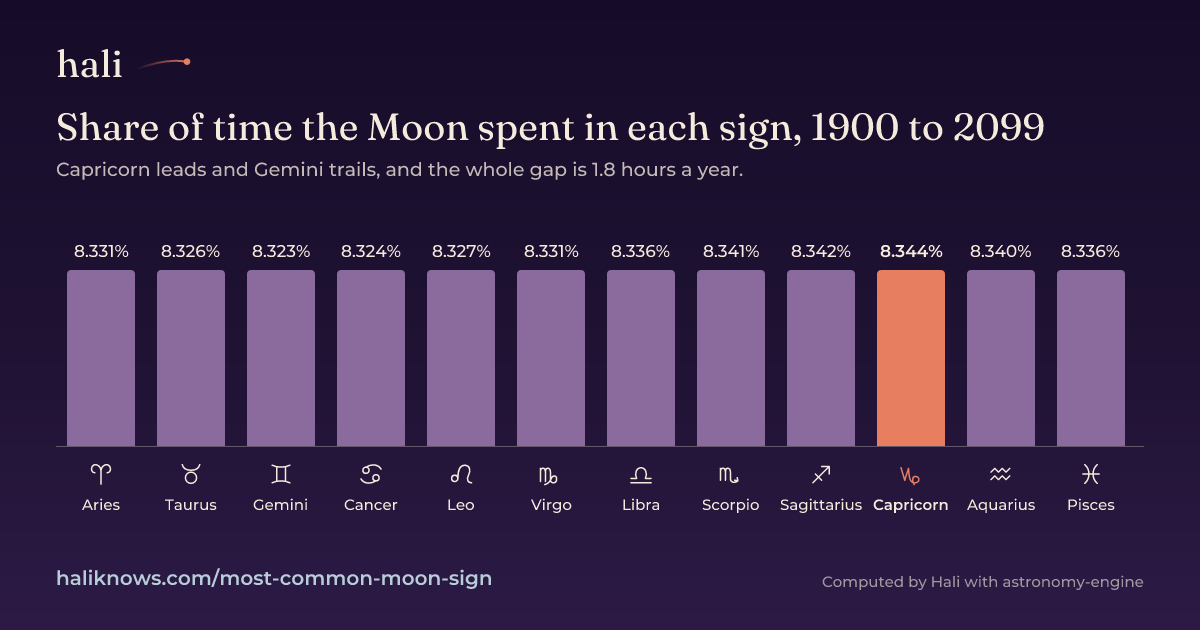
Capricorn, by a whisker. We followed the Moon through every sign change from 1 January 1900 to 31 December 2099, all 32,084 of them, and added up how long it spent in each sign. Capricorn got 8.344% of the time. Sagittarius came second with 8.342%, which leaves Capricorn ahead by about 6 minutes a year.
Out of every 10,000 people born in those years, about 834 have a Capricorn Moon and 832 a Gemini Moon. If every sign got exactly the same time, each would have 833.
| Moon sign | Share of time | Rank | Average stay in days | Shortest stay in days | Longest stay in days |
|---|---|---|---|---|---|
| Aries | 8.331% | 8 | 2.28 | 1.96 | 2.54 |
| Taurus | 8.326% | 10 | 2.27 | 1.96 | 2.54 |
| Gemini | 8.323% | 12 | 2.27 | 1.95 | 2.54 |
| Cancer | 8.324% | 11 | 2.27 | 1.95 | 2.55 |
| Leo | 8.327% | 9 | 2.27 | 1.96 | 2.55 |
| Virgo | 8.331% | 7 | 2.28 | 1.95 | 2.55 |
| Libra | 8.336% | 5 | 2.28 | 1.96 | 2.55 |
| Scorpio | 8.341% | 3 | 2.28 | 1.96 | 2.55 |
| Sagittarius | 8.342% | 2 | 2.28 | 1.96 | 2.55 |
| Capricorn | 8.344% | 1 | 2.28 | 1.96 | 2.55 |
| Aquarius | 8.340% | 4 | 2.28 | 1.95 | 2.54 |
| Pisces | 8.336% | 6 | 2.28 | 1.96 | 2.54 |
Each sign links to its own page, with the next dates the Moon is there.
What is the rarest Moon sign?
Gemini, with 8.323% of the Moon’s time. Calling it rare is generous. The gap between the most and least common Moon sign is 0.021 percentage points, which works out at about 1.8 hours a year, roughly the length of a film.
So if you’ve read that one Moon sign is much rarer than the others, the numbers don’t back it up. Sun signs vary more, as our study of real birth records shows, and rising signs vary far more, as the rarest rising sign study shows.
Why aren’t the Moon signs exactly equal?
Because the Moon doesn’t move at a steady speed. Its orbit is an ellipse, so its distance from Earth keeps changing, and it moves fastest when it’s closest, at perigee. The shortest stay in our 200 years happened with the Moon about 356,000 km away. The longest happened with it about 406,000 km away.
Across the whole window, stays with the Moon closer than 365,000 km averaged 2 days and 19 minutes. Stays with it further than 400,000 km averaged 2 days, 12 hours and 16 minutes. So whichever signs the Moon crosses near perigee lose a little time.
If the perigee stayed in one place, the sign it sat in would be clearly rarer than the rest. It doesn’t stay put. In our data it drifts forward round the zodiac once every 8.8 years or so, which means every sign takes a turn as the fast one, and over a long window the turns almost cancel out.
Almost, because the turns never land perfectly evenly. From 1900 to 2099, Taurus hosted the most perigees, 228 of them, and Libra the fewest, 213. Out of 2,651 in total, that’s a small wobble, and it leaves a small gap.
Does the most common Moon sign change over time?
Yes, and quite a lot from one decade to the next. In ten years the perigee only gets round the zodiac about once, so it doesn’t have time to even things out.
Across the 20 decades from the 1900s to the 2090s, 11 different signs took the top spot. Taurus never topped a decade. The gap between the most and least common sign in a decade ranged from 0.140 to 0.265 points, so the widest was about 13 times the gap over the full 200 years.
The perigee shows up clearly in the decades. In 10 of the 20, the least common Moon sign was the sign that hosted the most perigees that decade. In 18 of them, it was that sign or the one next to it.
| Decade | Most common | Least common | Gap in points |
|---|---|---|---|
| 1900 to 1909 | Leo 8.428% | Pisces 8.256% | 0.172 |
| 1910 to 1919 | Scorpio 8.465% | Taurus 8.202% | 0.263 |
| 1920 to 1929 | Sagittarius 8.455% | Gemini 8.257% | 0.198 |
| 1930 to 1939 | Aquarius 8.456% | Libra 8.235% | 0.221 |
| 1940 to 1949 | Aries 8.463% | Virgo 8.213% | 0.250 |
| 1950 to 1959 | Gemini 8.443% | Scorpio 8.255% | 0.188 |
| 1960 to 1969 | Cancer 8.454% | Capricorn 8.199% | 0.255 |
| 1970 to 1979 | Libra 8.396% | Aquarius 8.256% | 0.140 |
| 1980 to 1989 | Libra 8.459% | Aries 8.194% | 0.265 |
| 1990 to 1999 | Libra 8.426% | Taurus 8.258% | 0.168 |
| 2000 to 2009 | Capricorn 8.460% | Leo 8.210% | 0.250 |
| 2010 to 2019 | Aquarius 8.456% | Virgo 8.257% | 0.199 |
| 2020 to 2029 | Aries 8.455% | Sagittarius 8.232% | 0.223 |
| 2030 to 2039 | Gemini 8.464% | Scorpio 8.208% | 0.256 |
| 2040 to 2049 | Leo 8.446% | Capricorn 8.253% | 0.193 |
| 2050 to 2059 | Virgo 8.459% | Pisces 8.197% | 0.262 |
| 2060 to 2069 | Sagittarius 8.403% | Aries 8.255% | 0.148 |
| 2070 to 2079 | Sagittarius 8.458% | Gemini 8.201% | 0.257 |
| 2080 to 2089 | Sagittarius 8.418% | Leo 8.255% | 0.163 |
| 2090 to 2099 | Pisces 8.465% | Libra 8.205% | 0.260 |
Even the two centuries disagree. From 1900 to 1999, the most common Moon sign was Libra and the rarest was Taurus. From 2000 to 2099, it’s Aquarius and Virgo. So the honest answer to “what is the most common Moon sign” always comes with a date range attached.
How long does the Moon stay in a sign?
About 2.28 days on average, or 2 days, 6 hours and 39 minutes. The Moon goes through all twelve signs in about 27.32 days and changes sign about 160 times a year. Averaged over 200 years, every sign’s typical stay comes out between 2.27 and 2.28 days.
Single stays vary much more than that. The shortest in our window was the Moon in Cancer, from 3 January 1912, 17:25 UTC to 5 January 1912, 16:18 UTC, a stay of 1 day, 22 hours and 53 minutes. The longest was the Moon in Sagittarius, from 17 January 1947, 04:03 UTC to 19 January 1947, 17:11 UTC, a stay of 2 days, 13 hours and 8 minutes. That’s 14.3 hours longer, all down to where the Moon was in its orbit.
Can your birth date alone tell you your Moon sign?
Often, but not always. On 43.9% of days from 1900 to 2099, the Moon changed sign at some point during the day. That’s about 160 days every year. If you were born on one of them, your birth time decides your Moon sign, and two people born on the same date in the same town can have different ones.
The Moon sign calculator checks this for you. If the Moon changed sign on your birthday, it shows both signs and the time of the switch, in your local time.
Does a common Moon sign mean anything?
No. The differences are tiny, and how much time the Moon spends in a sign says nothing about anyone’s feelings, luck or future. If you have a Gemini Moon, you’re one of about 832 in every 10,000 people, which is plenty of company.
How we calculated this
We used the Moon from Hali’s chart engine, the same one behind every Hali chart. That’s the Moon’s apparent position seen from the centre of the Earth, measured along the tropical zodiac, from astronomy-engine, an open source astronomy library based on NASA JPL data.
We checked the Moon’s position every two hours from 1 January 1900 to 31 December 2099, and pinned down every sign change to the minute by halving the gap until it was a minute wide. Then we added up the time the Moon spent in each sign. A sign’s share is that time divided by the whole window. With births spread evenly in time, the share of time is also the share of people born with that Moon sign. Real births follow the seasons and the days of the week. The Moon visits every sign every month, so that should mostly average out, but we haven’t measured it.
Stays count only when they start and end inside the window. Perigees come from astronomy-engine’s own search for the Moon’s closest approach to Earth, and the decades are calendar decades, so the 1900s run from 1900 to 1909. Days with a sign change are counted in UTC. In another time zone a different set of days contains the changes, but the number of them is the same, because every change still lands on exactly one local day.
The script that builds the dataset is in our code, so every number on this page can be rebuilt.
Use this data
The full dataset is free to use under a Creative Commons Attribution licence (CC BY 4.0). If you write about it, please credit Hali and link to this page. For questions or custom cuts of the data, such as a different range of years, contact us at hello@haliknows.com.
Cite this study
The findings, the chart and the data are free to use. All we ask is a credit to Hali and a link back to this page.
The chart
Citation
Hali Knows team (2026). The most common and rarest Moon signs. Hali. Published 14 November 2026. https://haliknows.com/most-common-moon-sign
The data
Embed the chart
Paste this HTML into your page. It shows the chart and links back to the study.
<a href="https://haliknows.com/most-common-moon-sign"><img src="https://haliknows.com/charts/most-common-moon-sign.png" alt="Bar chart of the share of time the Moon spent in each zodiac sign from 1900 to 2099. Every bar is close to 8.333%, from 8.323% for Gemini to 8.344% for Capricorn." width="1200" height="630" style="max-width:100%;height:auto"></a>
<p>Chart by <a href="https://haliknows.com/most-common-moon-sign">Hali</a>, CC BY 4.0</p>Hali's findings, chart and data are free to use under a Creative Commons Attribution licence (CC BY 4.0). Credit Hali and link to this page. Read the licence
Questions people ask
What is the most common Moon sign?
Capricorn, but only just. From 1900 to 2099 the Moon spent 8.344% of its time in Capricorn, against an even share of 8.333%. Sagittarius was a close second at 8.342%, and every Moon sign was within 0.021 percentage points of every other.
What is the rarest Moon sign?
Gemini, with 8.323% of the Moon's time from 1900 to 2099. That makes it the least common Moon sign, but only by about 1.8 hours a year, so no Moon sign is really rare.
Is any Moon sign rare?
No. Every Moon sign gets close to an even twelfth of the Moon's time. Out of every 10,000 people born from 1900 to 2099, between 832 and 834 have each Moon sign. Rising signs vary far more, depending on where you were born.
How long does the Moon stay in a sign?
About 2.28 days on average, or 2 days, 6 hours and 39 minutes. From 1900 to 2099 the shortest stay was 1 day, 22 hours and 53 minutes and the longest was 2 days, 13 hours and 8 minutes. Stays are shorter when the Moon is close to Earth, because it moves faster there.
Why does the most common Moon sign change from decade to decade?
Because the point where the Moon comes closest to Earth, its perigee, drifts round the zodiac about every 8.8 years. The Moon moves fastest near perigee, so the signs it crosses there get slightly less time. Over a single decade that is enough to change the winner, and 11 different signs topped at least one decade between 1900 and 2099.
Can I work out my Moon sign from my birth date alone?
On most days, yes. But on 43.9% of days, about 160 a year, the Moon changes sign at some point, and then your birth time decides. The Moon sign calculator shows both signs and the time of the switch.
How often does the Moon change sign?
About 160 times a year, or once every 2.28 days on average. It goes through all twelve signs in about 27.32 days.
Can I use this data?
Yes. The dataset is free to use under a Creative Commons Attribution licence (CC BY 4.0). Please credit Hali and link to this page.
Sources
- Moon positions from astronomy-engine (MIT licence, based on NASA JPL ephemerides), the library behind every Hali chart
- Computed by Hali for 1 January 1900 to 31 December 2099 UTC, with every Moon sign change found to the minute (site/scripts/moon-sign-rarity.ts)
- Lunar perigees from astronomy-engine's own search for the Moon's closest approach to Earth